
Welcome to my personal website! I am a PhD candidate in Economics at Université Paris-Dauphine–PSL, supervised by Prof. Gianluca Orefice, and an external researcher at CEPII. From February to May 2025, I visited Columbia University, invited by Prof. Noémie Pinardon-Touati.
My research lies at the intersection of international trade, macroeconomics and industrial organization. More specifically, my research analyzes cost shocks and their effect on inflation, with a particular focus on differential pass-through along the lines of market power.
I will be on the academic job market in 2026–27.
Contact:
LEDa
Place du Maréchal de Lattre de Tassigny
75775 Paris Cedex 16


Working Papers
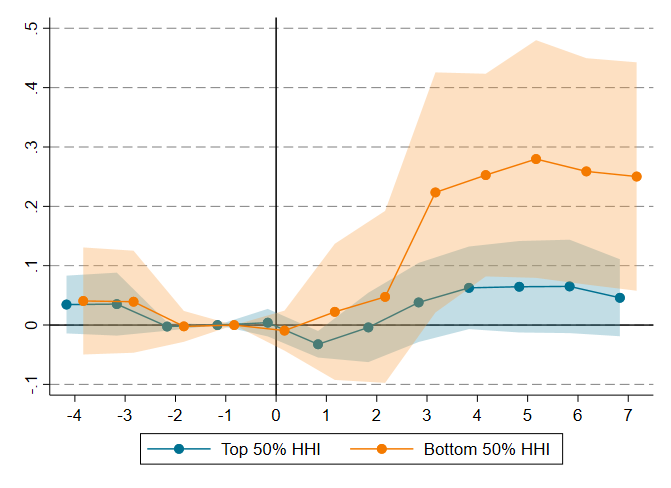
Firms increase markups following a decrease in import prices because of imperfect cost pass-through. This paper analyzes an understudied, countervailing effect: as more firms are induced to import (extensive margin), each individual firm is forced to pass through more of their cost reductions in order to retain their market position. I introduce a partial equilibrium model of monopolistic competition under non-CES demand, in which firms choose to either import an intermediate or to source it domestically. The model reveals the theoretical link between the extensive margin and pass-through, and yields a simple way to estimate the relevant parameters in the data. I then quantify the extensive margin for French firms, using detailed product-level price data on both the output and input side. Results show that the extensive margin is sizable, a 10% increase in the marginal cost savings potential from sourcing from abroad increase the share of firms importing by 3.9%. A quantitative exercise using a sufficient statistics approach and parametrizing a Kimball demand system suggests that the extensive margin can explain around 16% of the decrease of the aggregate price index following a 10% reduction in foreign prices.
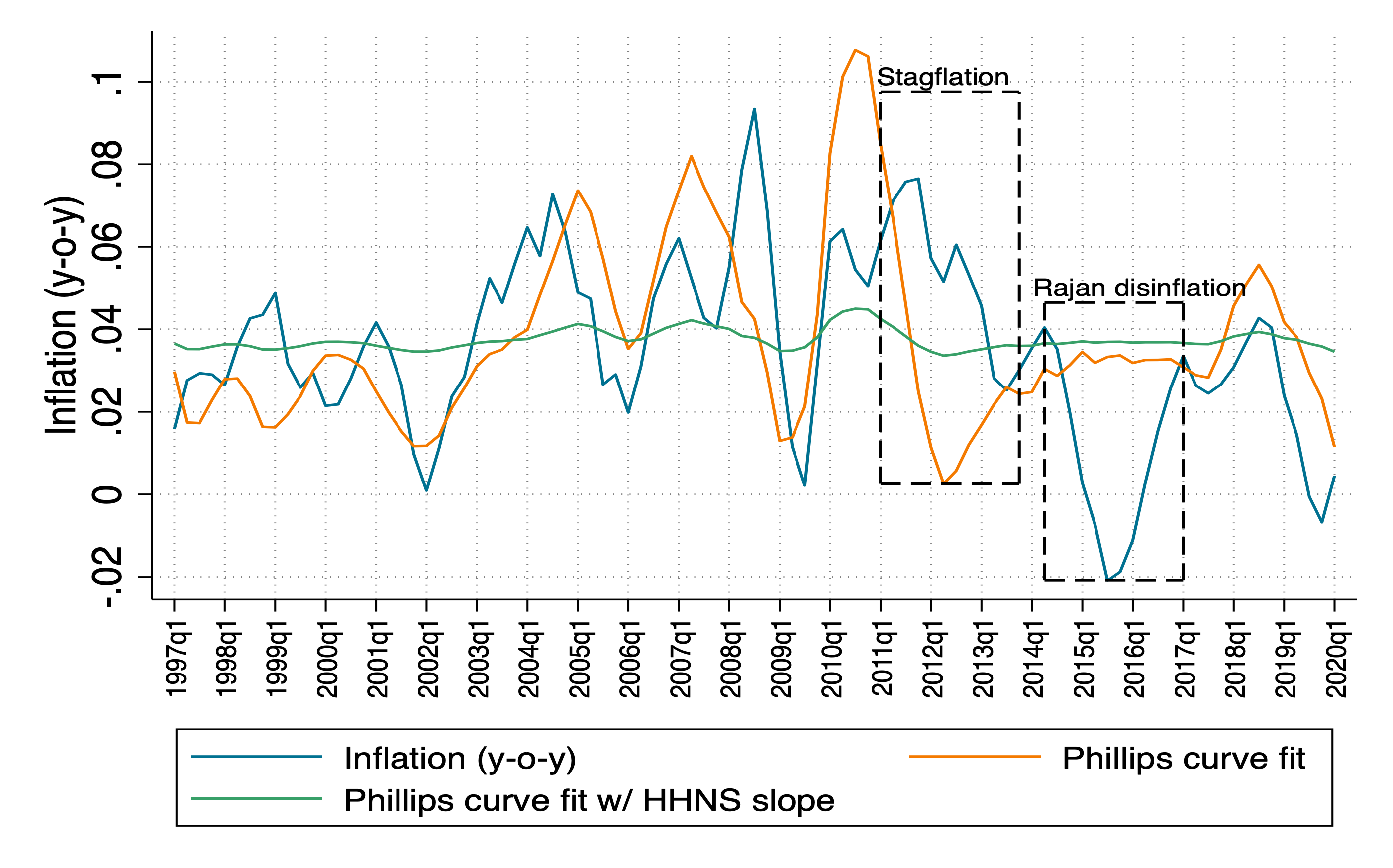
We estimate the Phillips curve for India to shed light on the output-inflation tradeoff in developing economies. We develop a method to estimate the slope of the Phillips curve based on sufficient statistics that apply to a broad class of New Keynesian models. Using portable causal research designs, we estimate the firm-level passthrough of cost shocks into prices at different horizons, and the slope of marginal cost curves at different levels of aggregation. These empirical moments map into the slope of the Phillips curve and yield a decomposition into three terms: price rigidity, micro real rigidities, and macro real rigidities. The slope of the Phillips curve in India is one order of magnitude steeper than in the United States. This difference is explained by weaker macro real rigidities and less rigid prices. Extending the model to allow for input misallocation, we find that the re-allocative effects of monetary policy affect the Phillips curve, but this effect is small.
Work in Progress
Policy Papers
CV
You can find my CV here.
Teaching
Université Paris Dauphine–PSL · 2022–2027
Université Paris Dauphine–PSL · 2025–2027